

Friction in a platform is never just a technical problem. It's never just an organizational one either.
Most advisors understand one side. Engineers see the technical constraints; executives see the business pressure. I've spent twenty years on the technical side — and learned that the decision always lives where the two meet.

Who this is for
- Your team wants to buy a product or service — but the real problem is friction, and no tool fixes that
- Developers still open tickets to get things done — self-service is a goal, not a reality, and the toil is becoming impossible to ignore
- Your AI initiatives are stalling because the platform wasn't designed for agent workloads
- You're about to make a significant architecture decision and want one conversation with someone who has seen this before
- You've just been promoted or joined a new company and are trying to make sense of the platform situation — what's broken, what matters, and where to start
If that's where you are, keep reading.
Google and AI have the knowledge. I have the scar tissue.
— Tomasz CholewaHow I work
Diagnostic session
A fixed-price, 90-minute conversation focused on one real decision. Written summary within three business days. No pitch at the end.
Learn more →Advisory retainer
Ongoing access to judgment for leaders who want a trusted outside perspective. Monthly, async access between sessions, no implementation scope.
Learn more →I also run regular free webinars. See previous and upcoming sessions →
My position
I've spent twenty years watching consulting companies and vendors sell products and services that didn't deliver the value promised. Advisory wrapped in a sales cycle. Recommendations shaped by partnerships. Tools presented as solutions before the problem was properly named.
My position is simpler: no vendors to protect, no partnerships to preserve, no implementation team to keep busy. When I tell you something doesn't make sense for your situation, there's nothing behind that opinion except the pattern I've recognised across dozens of similar organisations.
That independence isn't a marketing claim. It's structural. I don't implement, so I have no incentive to make your situation more complex than it is.
A platform decision is never purely technical. But it's also never purely organizational. The engineers see the constraints; the executives see the pressure. Almost nobody sits at the point where those two views converge — and that's where the real decision lives.
Twenty years of implementation work gives me the technical depth to evaluate what's actually possible. Working directly with CTOs and VPs gives me the business context to evaluate what actually matters. The advisory is useful precisely because I don't have to choose which lens to use.
My first job as a Linux engineer, I automated everything I could touch — not because anyone asked me to, but because repetition felt like waste. Manual steps meant waiting, mistakes, and dependency on whoever held the knowledge. That instinct has never left me.
Infrastructure as Code was the first time the industry gave that instinct a name. GitOps was the maturation of it: not just defining infrastructure as code, but managing the entire platform lifecycle — deployments, configuration, policy — through Git, with automated reconciliation. No tickets. No manual steps. No bottlenecks waiting for the right person to approve a change.
The underlying principle is an API-driven, self-service platform. When everything is code, developers don't wait. Changes are reviewed, auditable, and reversible. The platform becomes something teams trust rather than work around.
Most platform adoption problems I see trace back to friction. Teams don't use a platform because using it is harder than not using it. The fix is rarely more tooling — it's removing the manual steps, the tickets, the gates that make the platform feel like an obstacle.
AI has changed what implementation costs. A Kubernetes manifest, a pipeline, a deployment script — these are now seconds away for any engineer. That shifts the real question: not how to build, but what to build, when, and at what architectural cost.
Working closely with AI and seeing its impact across engineering organisations, one thing is clear: the platforms being built today weren't designed for agentic workloads. The gap is structural — access models, audit trails, non-determinism, GitOps-native change management.
Teams that treat AI readiness as a platform architecture problem now will have leverage. Teams that wait until agents are already in production will spend their time on remediation.
The connection to friction is direct: AI agents cannot be fully leveraged on a platform that runs on legacy processes — tickets, manual approvals, undocumented procedures. To get real value from AI, you must first have a platform where everything is defined as code, managed via API, and operable without human intervention at every step. Reduce friction first. Then AI multiplies what you've built.
Featured thinking
 What is Continuous Data Recovery Testing
Once you follow the practices that I preach about defining and maintaining your whole platform with code, you’re simplifying and speeding up the recovery process. It’s a huge gain for an organization that prepares for the worst. It’s part of the “Design for Failure” principle that has been a part of best practices within the platform architects’ community.
 7 lessons from writing AI agents for platforms
I decided to bet on AI agents and started writing them a long time ago. There are many reasons, but the main one is pure laziness. I’ve always wanted to automate things, and that’s why I became a DevOps engineer in the first place.
 5 Challenges of Using AI for Platform Engineering
AI is transforming software development, but platform engineering presents unique challenges. While LLMs excel at writing application code, they struggle with platform management tasks. Here are the 5 key challenges and why platform engineering needs a different approach to AI.
What clients say
"Tomasz has played a crucial role in revolutionizing our software delivery processes. His deep insights and expertise have been instrumental in helping us achieve our objectives and embrace the Cloud Native approach to modern application development."
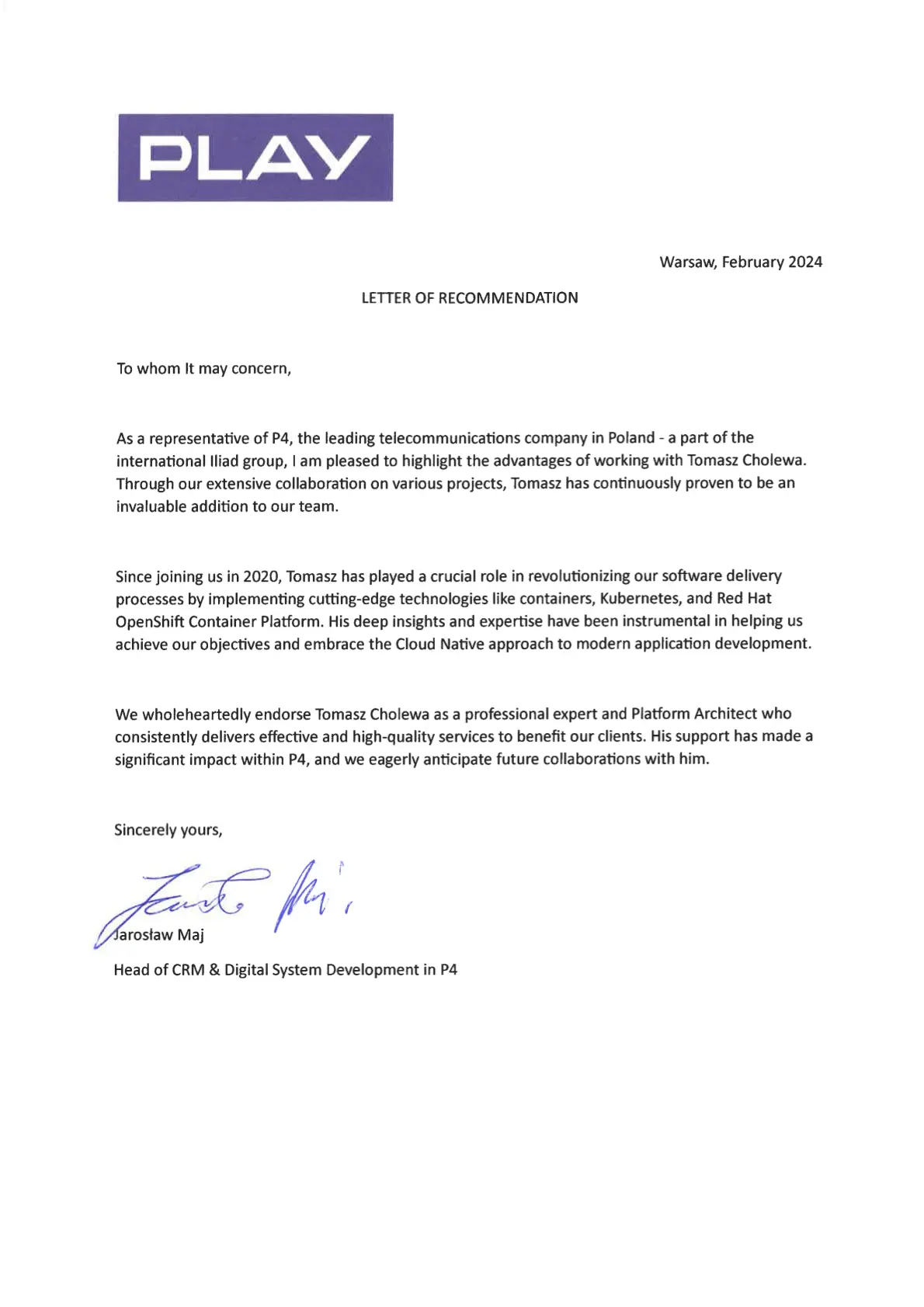
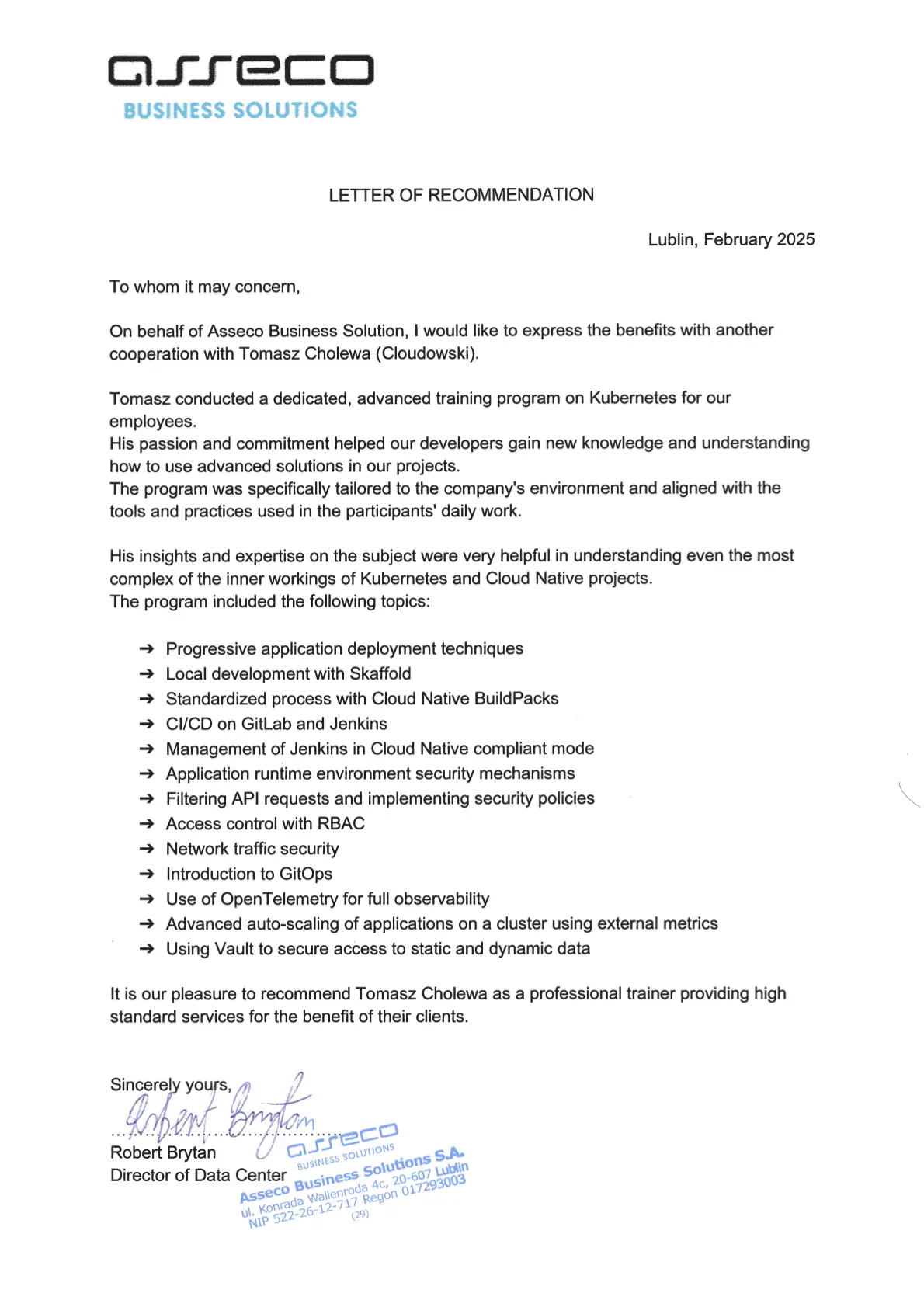
"His insights and expertise on the subject were very helpful in understanding even the most complex of the inner workings of Kubernetes and Cloud Native projects. The program was specifically tailored to the company's environment and aligned with the tools and practices used in the participants' daily work."
Start with one conversation.
The diagnostic session is a fixed-price, no-obligation first step. If it's not the right fit, I'll tell you.
Book a diagnostic call